How the Placement Angle Affects All-on-4 Implants
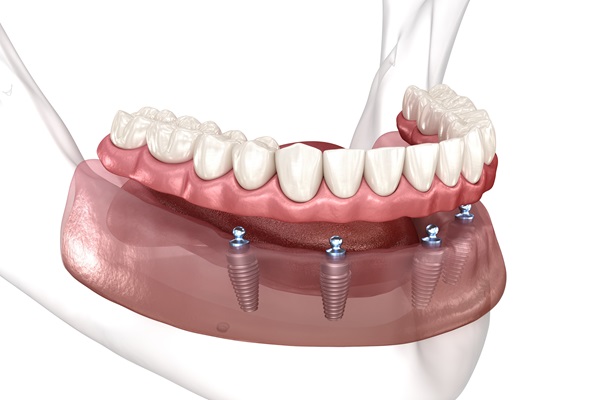
For people dealing with significant tooth loss or dental damage, All-on-4® dental implants can be an excellent solution. This treatment option allows patients to restore multiple teeth without using an individual implant for each tooth. Instead, four dental implants are strategically placed within the dental arch to secure a dental prosthetic that replaces the entire row of natural teeth. There are several good reasons to choose the All-on-4® implants option, and many of these benefits are due to the nature of the placement procedure.
The process of placing All-on-4® implants
To begin, a dentist evaluates the individual's overall jawbone structure to determine whether the patient is a good candidate for this type of procedure. Those with weakened bone structures or significant bone loss may need a bone graft first. However, the placement angle of the All-on-4® procedure allows many patients to skip this step. Also, any remnants of the natural teeth need to be extracted as another part of the preparation process.
Once the mouth is fully prepped, the implants are surgically inserted below the gum line in specific locations near the jawbone. The first two implants are placed toward the front of the mouth, usually underneath the smaller incisors. These implants are installed vertically at a 90-degree angle for maximum strength and stability.
The other two implants are placed near the first set of bicuspids or premolars. However, unlike the front implants, these are placed at a 45-degree angle. The jawbone is significantly less dense in this area, so placing the implants at this angle allows them to stay rooted toward the front of the mouth where the bone is more solid and sturdy. As the implants heal, they permanently fuse to the bone, allowing for continued support while stimulating these hard tissues for better bone health.
For many people, their new denture or bridge can be attached to the implants within just a day or two after the surgery. Because the implant and abutment are placed at the same time during the All-on-4®procedure, there is rarely a need for multiple surgeries. While the treatment can be completed in just a few days, your mouth will continue to heal for several months.
The benefits of implant-supported dentures
There are many options for those who have lost only one or two teeth. However, those who are missing more than four teeth in a row, as well as those who have significant damage throughout the mouth, may need dentures instead. While dentures can restore the look and function of the missing teeth, they do come with a few drawbacks:
- Dentures must be secured daily with an adhesive that can wear off during the day.
- Dentures can slip loose while eating or talking, creating an embarrassing situation.
- It can be difficult to eat certain foods when wearing dentures.
- People who wear dentures are more likely to experience bone loss and changes in facial structure over time.
- Dentures must be removed and cleaned at night, making them more prone to accidental damage.
All-on-4® implant-supported dentures eliminate these problems by creating a stable, permanent structure for attaching the dentures. The result is a more secure fit that helps improve comfort and confidence. Also, the implants help stimulate the bone tissue to significantly reduce bone loss in these areas.
The process of receiving implant-supported dentures is invasive, but it offers speedy results. Traditional implants require multiple surgeries with months of healing in between each one. This means it can take well over a year before the treatment is complete. Many people prefer a faster alternative to replace their missing teeth. While the All-on-4® option is an investment, it usually costs significantly less than replacing multiple teeth with individual implants.
It is important to note that just as with any kind of surgery, there are risks involved with this type of treatment. In addition to a small chance of developing an infection, there is also a possibility the implants may fail. While this is rare, it can happen, especially in patients with pre-existing medical conditions that prohibit proper healing. Not taking proper care of the implants with daily hygiene practices can also cause implant failure.
Conclusion
If you are facing severe tooth loss, All-on-4® implants can help restore your smile while offering a host of dental health benefits. The unique placement angle of these implants allows many people to enjoy a beautiful smile, including those with bone density issues. Talk with a dentist to determine whether or not this approach is right for you.
Request an appointment here: https://www.cdcdentalcenter.com or call CDC Dental Center at (818) 985-1148 for an appointment in our North Hollywood office.
Check out what others are saying about our dental services on Yelp: All-on-4 in North Hollywood, CA.
Related Posts
All-on-4 implants can replace a full arch of missing teeth using four strategically placed dental implants to support a fixed prosthetic. This approach often appeals to patients who want a stable, non-removable option that feels closer to natural teeth than traditional dentures. A general dentist evaluates candidacy based on oral health, bone support, bite forces,…
All-on-X provides full-arch restoration for those with missing or severely damaged teeth. By using strategically placed dental implants, the treatment supports a permanent set of replacement teeth, creating a natural-looking and functional smile. Unlike traditional dentures, All-on-X offers a stable, long-lasting solution that improves the overall health and appearance of your smile.Unlike removable dentures, all-on-X…
The All-on-4® system provides people who have lost most of their teeth with a more convenient alternative to dentures. It combines two of the most popular dental restorations — implants and dentures —to craft a new smile. Dentists typically recommend All-on-4® for people who have lost most of their teeth.Implants are the most effective way…
Dental implants are one of the most reliable and lasting solutions for replacing missing teeth. Unlike traditional dentures or bridges, implants integrate with the jawbone to provide a stable foundation for artificial teeth. While many patients benefit from implants, not everyone is an immediate candidate. Certain factors must be evaluated to determine eligibility, and for…